How to Get Help When You Can’t Ask

By Jacey Eckhart

Have you ever needed help during a Next Door Project but could not make yourself ask?

During one deployment, I really, really needed help. I was pregnant with our third child, experiencing morning sickness all day long, and, well, kind of falling down in a faint from time to time. Copious vomiting does that to people.

I wasn’t having trouble getting help because I was an idiot. I was having trouble because I could not just walk into Target and buy support right next to the maximum strength bras and industrial strength panties. Believe me, I tried.

I could not bear to call someone up and ask her to pick up my kids from swim team. Or babysit so I could get to the doctor. Or feed me during the three minutes a day I was not vomiting.

Partly it was me and my heinous pride. I did not want to be a burden. I did not want to look pathetic or weak, especially when I was pathetic, weak, and, of course, visibly green. I could not risk the shame of having someone tell me no or give me a lame excuse and make me feel even worse than before I asked.

Then I discovered the magic word that made help miraculously appear.

Not “please.” That’s a good magic word, and it works most of the time.

The magic word was “HOW.” How do I find a babysitter around here? How would you find a carpool for swim team? How did you manage meals during your pregnancy?

Sometimes people told me how and their ideas were even better than mine. Even better than that, sometimes the “HOW” sparked an unprompted desire in the other person to help me. I think it was because the word “HOW” implies that you are trying to help yourself.

It’s kind of like that bit Chris Rock does about driving his broken-down car: “When I stood there trying to flag someone down, nobody stopped. But when I pushed my own car, other drivers would get out and push with me. If you want help, help yourself—people like to see that.”

You deserve a little help during your Next Door Project, not only because you are going through something big, but also because you are the kind of person who would be happy to help other people. So this week, purposely try the magic word “HOW.” Followed by the other magic words “PLEASE” and “THANK YOU.” Because people do, in fact, like to see that—and help you on your way down the hall to your Next Door.

How Do I Know If This Is a Mistake?

By Jacey Eckhart

My daughter’s fourth grade teacher told the class that she knew her marriage was a mistake the day she got engaged. (Why the teacher was telling a bunch of ten year olds about her divorce is beyond me, but I bet it was a slow day and the air conditioning was out.)

Anyway, she told the class she drove down the street right after she said yes to getting married and all she could see were STOP signs everywhere. Signs that said NO. Signs that said DON’T.  She went ahead with the marriage and ten terrible years later she got divorced.

That story scared the beejeeb out of my daughter and her friends. To this day they all fear commitment and break out in hives at the sight of a stop sign. 

Okay, not at all true. 

Still, how do you know when you are making a mistake before you make it—especially when you are going through a #siglifechange? How do you know if you are knocking on the wrong door?

Because we do knock on the wrong doors all the time. Human beings have this thing called affective forecasting, which means we are surprisingly bad at predicting what will make us happy in the future. We charge past the warning signs and sail right through wrong doors, alone and unafraid.

Recently I agreed to take a job that I worried was not quite right for me. In addition to the presenting and coaching I did want to do, the job also required a few things I did not want to do. Like use PowerPoint. Stick to a schedule. Forgo my Lucky jeans in favor of pantsuits and heels.

The night I said I would take the job, I dreamed I was putting brown shoe polish on a high-heeled red shoe. Doesn’t take Freud to figure that one out. I woke up in a sweat. “It’s a sign,” I told my husband, gripping at his chest hair.

“It’s not a sign,” he said, wincing as he unpeeled my fingers. “Your brain is thinking through all your options.”

“It feels like a mistake,” I cried.

“Most changes feel like a mistake when you are going through them,” he said. “Too little data to judge it all at the beginning. It is a good risk.”

Easy for him to say. Because unlike Mr. Trust Your Decisions, I want a green light as big as my house. I want a sign from God himself that tells me what to do because I don’t want to waste any time on the wrong thing. I don’t want to hurt or disappoint. I want to be right every time.

I’m hilarious like that. Maybe it is important to know the experts in affective forecasting say that we are much more likely to accurately predict the positive effect of events on our lives.  We are much more likely to overestimate the negative effects of things and underestimate our ability to adapt.

So far, I’m pretty sure my new job is not a mistake. If you don’t read the PowerPoint slides out loud to people, it is a lot less boring. The timeline works just fine. And I look pretty good in a pantsuit—especially with those high-heeled red shoes.


How to Choose Your Next Door

By Jacey Eckhart

Who says opportunity knocks? Opportunity grudgingly comes to the door, grumpy and hung over, only when you beat upon that door with your tiny fists.

So, get to it. You are ready. You might even be feeling some excitement right now.

Right up to the moment you turn and look down the long hallway. It’s an improbably long, twisty, mathematically impossible hallway. You see many doors down there. Big ones, small ones, fat ones, skinny ones. Red and blue and green and yellow and black ones. It looks like M.C. Escher and Dr. Seuss had a twisty little baby and it was a hallway. So how do you know which door to knock on first?

Good question, kid. Choices are not new to you. It is estimated Americans make 35,000 nearly conscious decisions per day. Sometimes you go with your gut. Sometimes you do what is best for other people. Sometimes you avoid the decision completely or let someone else choose for you. A Next Door decision puts you right in front of the paradox of choice. The more choices you have, the more anxiety you get, the more you fear the consequences of making the wrong decision.

Since it is so hard to know what to do, right now concentrate instead on the don’ts.

Don’t focus on what you want to do most. You might not recognize it at first. Do the easy thing and identify what you know you DO NOT want to do. We all know instinctively what we don’t like. I definitely do not want to work outside in the snow because I cry easily when I am cold. I don’t want to fly across the Atlantic Ocean every day because I have a very flat bum and it goes to sleep easily. I don’t want to live where the sun does not shine. Make a list of what you don’t want to do.

Don’t pretend you need to know your “passion” or “purpose.” In the research for his book, So Good They Can’t Ignore You, Georgetown professor Cal Newport found that not everyone has a passion. Instead, successful people developed a passion for their work when they were good at their jobs. Granted, you cannot ignore what you know you DO NOT want to do, but you can try a little harder for a little longer to figure out if this is something you do want to do.

Don’t think about rewards. Sometimes the most unexpected benefit of the long hallway is the privacy. In the darkness of the hallway you can admit your truth. Is it money you want most? Or intellectual stimulation? Or working with people you truly like? Or living near your mom or your grandkids? Or doing something meaningful? Or having an outlet for your burning creativity? Maybe you want to reject the hassle of all those things and opt for a more simple, stress-free life. Once you admit what it is you want, own up to the price you are willing to pay in order to get it. Long hours? Business travel? The agony of coming up with a new idea every day? Less money? Traffic? Pick your poison.

Don’t spend any more time thinking stuff up. Instead, get it all down. Make a concrete list of the possibilities you truly will consider and the doors you are willing to (maybe) knock on. Generate as many ideas as you can. Work on those. Come up with new ideas.

Don’t ignore what makes you mad. Positive energy is not the only energy. Yes, people can do their best work when they work with what they love or what is leaning closest to their sled. But the thing they loathe has every bit as much power. Which choice has the most energy behind it?

Don’t forget to do the easy cuts. Do a little research on the doors in front of you. Just because they exist does not mean you have to knock on them. Read up on school districts in the areas you plan to buy a house. Research the majors or jobs you dream of doing on Vault or Glassdoor or MyNextMove.org, an online tool from the Department of Labor.

Don’t skip the experimental stage. Just because a door cracks open to you does not mean you have to barge through it. You can stand on the threshold and look inside before you go in. Bill Burnet and Dave Evans from Stanford’s d.school suggest that you devise some short-term experiments to see if your solution will work. The goal, they say, is to fail fast and fail forward. Do an internship. Teach a one-day workshop. Start a blog. Go to some conferences or trade shows. Drive from your dream house to your job in real-time traffic. Get real-time data.

Don’t neglect the imagined lives exercise.

Most people do not live their lives in one unbroken line from A – Z. Instead, they live in two- to four-year phases. Imagine what your life could be like in three months, three years, and thirteen years. Try to see it, hear it, smell it, feel it, taste it.

You can figure out what you really want to do, but you cannot figure out if that first door is going to be a winner. Have a little patience and just keep knocking.


What to Do with Too Much Change

By Jacey Eckhart

Who am I kidding? Life changes do not line up neatly like third graders choosing sides for kickball. Changes don’t plead with their puppy dog eyes, begging for you to pick them first.

When change happens—especially a lot of changes at once—it is a lot more like being swept up by a riotous crowd storming the Bastille than shuffling into line for kickball. #Siglifechange is not orderly. Or patient.

I was thinking about this last weekend. One of our friends retired from the military one day and got married the next. “Everyone was in town anyway,” Kurt told me logically.

All the guests really appreciated Kurt’s efficiency and the perfect sunshine that tumbled down from the sky as a blessing on the newlyweds. It made perfect sense to do both events at once.

Still, that’s a lotta change.

Which does not make it wrong. It isn’t wrong to do more than one change at a time, especially when it comes to developmental or transitional change.

Developmental changes come on you because it is time—like military retirement. You know it is coming and you kind of mentally prepare as well as you can.

Transitional changes—like a wedding or a new baby—occur because they are clearly the next step in a process. They disrupt things, yeah, but they have their own timeline and they happen when they happen.

Then there are transformational changes, which may cause a lot of riotous upheaval and the purchase of a guillotine of your very own. Transformational changes are chosen changes, like losing a lot of weight, or looking for a better job while you are already employed, or starting a new business.

I read once that when you are going through a big change, you handle it by not taking on any other big changes. At the time, we had just been displaced by a hurricane and two weeks later our son was diagnosed with autism. It would have made sense to chill in place for a while.

But that was also the month I got offered a contract to make a CD, which came with an accompanying speaking tour. My mom, who knows everything, told me the same thing she used to say when we wanted to attend rock concerts and she was afraid there could be a stampede (you know, cuz that is common). She told me, “If there is a riot, you keep on your feet, you don’t fall down, and you go with the crowd until you can edge your way to the side.”

I think this is the way to handle a lot of changes. Keep to your feet. Don’t fall down. Surf until you can get to the side and catch your breath. Then get ready to jump back in again and keep on going.

Are you experiencing a lot of changes, too? Download this worksheet and circle all the changes you have gone through in the past twelve months. Are you surfing all that change or are you being led to the guillotine?

Choose Me. Pick Me. Love Me: The Screen Test for Your Next Door Project

By Jacey Eckhart

No sooner did I complete my Next Door Project and start my awesome new job when the knocking started. A pack of possible Next Door Projects was at the door, calling my name, trying to get me to come into the hallway with my ice bucket, ready for change. Mine whisper their temptations through the keyhole and sound like this:

“Hey, J. Remember how you always wanted to buy a fixer upper? Look at this 100-year-old house on Realtor.com with no kitchen!!!”

“Psst, are you wearing a fur coat? Or is that the same 20 pounds you have been trying to lose since 1994 around your waist?”

“Pardon, but it isn’t enough to write a novel. You have to market it too. With devotion. When were you going to start that?

How do you choose a Next Door Project?

You are probably sensible and make a list of pros and cons or something. That would be smart. Instead, I have my own ways to think through choices, and I’ll share them with you this month.

The Screen Test

One of the ways I think through choices is to figure out which of three categories they fit into: a) the ones I love; b) the ones that love me; and c) the ones that own me. I can only tell them apart because they sound like some of my favorite characters from the big and little screen. See if these sound familiar:

The Meredith Grey Option

This Next Door Project choice is the one that loves you best. This choice is like Dr. Meredith Grey in Grey’s Anatomy when she is begging Derek to dump his ex-wife and stay with her because she loves him. “Pick me. Choose Me. Love me,” Meredith says. (Such a great line, Shonda Rhimes.) This choice is probably the fixer upper for me.

The John Cusack Option

This NDP choice is the noble underachiever looking for a dare-to-be-great situation. This is the one who loves you like crazy, but is kind of homely on the outside—like Lloyd Dobler in Say Anything. It stands outside your window with a boom box over its head, begging you to realize greatness coming for you if you just go out to meet it. This one is the novel, definitely.

The Kathy Bates Option

This one is the choice you are bound to, the choice that keeps breaking your legs every time you try to get away from it. This is Annie Wilkes in Stephen King’s Misery, determined to get what it wants out of you even if it has to kill you to do it. This, I fear, is the weight loss goal.

Choosing something because you love it, or it loves you, or you are bound to it can all lead to great things. Think through your possible Next Door Projects. Do you have any that would fit in these categories? Are there other categories I haven’t thought of? Let me know.


Are We There Yet?

By Jacey Eckhart

I woke up happy this morning. It rained for a week straight, which reminded me how we moved back to the States from rain-drenched Norway exactly one year ago.

Call me shallow, but I was so glad to come home. Back to my family. Back to the sunshine and the (mostly) blue skies. Back to the beach and bare feet and fresh peaches and the perpetual surprise that is…Marshalls.

After a year of knocking on doors like crazy looking for the right job and the right life, my career Next Door opened at last. I think I am through the Next Door. But how does anyone know they made it for sure?

After all, it took a ridiculously long time to get here. I can't help but feel a certain amount of shame that I could not make it happen sooner. Brad says that is like being ashamed I could not make corn grow faster or strawberries ripen.

True enough, I guess. William Bridges, author of the iconic book Transitions: Making Sense of Life’s Changes, says that there is no rushing the neutral zone. It takes a lot of time to get through it and there are no shortcuts.

Which seems silly to me. It is ridiculous how grinding the long hallway can be during a Next Door Project, isn’t it? Surely it would be so much more efficient if we could sign up for our Significant Life Changes like moves and new jobs and new family members in an orderly fashion at a convenient time.

When I do all the work of a #siglifechange, I want the Next Door to open to the sound of trumpets. I want confetti. I want a heavenly host singing “Hallelujah” at the very least so I am ready to enjoy it right away.

Instead the Next Door opens with a whisper. You only recognize it because you have been here before. 

And I have been here before. I do know this feeling. I felt like this when I was 21 and woke up with my head on Brad's chest months after our wedding and my mom called and she was not surprised to find Brad in my bed. I felt like this when I first saw my own picture in the newspaper next to my byline. I felt like this at Christmastime surrounded by my grown kids and their lovely spouses and my little granddaughter at last. I still feel like this every time I stand before an audience.

This is what the Next Door feels like: Complete. I feel for a moment, the smallest moment, the tiniest time, complete. Calm. In sync. What bliss.

If you are still in the middle of your long hallway full of nothing but closed doors, take a minute and look up. I opened a window for you. The sunshine and warm breeze blowing in is a reminder of what is to come. Or, it is pollen because I forgot about all the pine trees out there.

Either way, keep moving forward. Keep knocking. Because it is the only way to get to your Next Door to open.

How to Wait for Bad News

By Jacey Eckhart

Major life changes often come with a long wait for the Bad News Fairy. She is just one of the fun monsters waiting around your hallway before your Next Door opens, carrying news about the acceptance board, or your bar results, or the lab test on that funny (not funny) lump they found in your breast. Is there anything we can do to make the wait easier?

Definitely. Kate Sweeny and her team of researchers at the University of California, Riverside, study how people like us cope with uncertain waiting periods. I talked to Sweeny about waiting for a military board and other kinds of (potentially) bad news. Here are her tips:

Play Ultimate Frisbee. Really.

Most advice about waiting involves distracting yourself: Go for a walk. Do a chore. Help others. Those suggestions are a good start, Sweeny says, but they don’t go far enough.

“The kinds of things that really absorb us are not passive activities, but challenging activities,” says Sweeny. “You are looking for something that makes you feel challenged, but not to the point you are defeated and overwhelmed.” 

What creates that kind of flow for you? Work is often the best solution, says Sweeny. Exercise classes, like hot yoga, or team sports, like basketball and Ultimate Frisbee, can give the body and the mind a needed break from worrying.

Give up your crystal ball.

When you think you have “a feeling” that the Bad News Fairy is waiting to tell you the board results are negative or the cancer test is positive for every kind of cancer in the world, know you are NOT predicting the future. 

“As we approach the moment of truth we become more pessimistic,” says Sweeny. “It happens to almost everyone.” Expecting the worst as the end draws near is one of her most consistent findings.

“We have a tendency to look at feelings as information,” says Sweeny. Be assured those feelings are not particularly accurate, according to the research. Instead, they are probably a mechanism that helps us prepare.

Clear the decks.

Go ahead and play along with your pessimism. Sweeny’s research shows that people who make practical changes that would make the blow of bad news less severe do a little better with either outcome. Do a little proactive coping now—put off an expensive vacation, assemble a sample resume, send out another copy of your manuscript. It helps.

Hold onto hope as long as possible.

Since you know you are going to get more pessimistic as the due date gets closer, hold onto an optimistic outlook as long as possible, advises Sweeny. Tell yourself things will probably go your way. 

“Everything I studied shows it is ideal to expect the best as long as you can and then switch that strategy in the final days, hours, minutes and brace for the worst,” Sweeny says.

Waiting for a decision or a test or a result that will change your whole life is no joke. Instead of being overwhelmed by the wait and the worry, plan to deliberately cope with a challenging wait with a plan. Write it on your calendar: We will not worry until this date. 

And then get on with it—because that is what all of us working on a Next Door Project do best.

What Other People Think

By Jacey Eckhart

My friend Jeanne called me to task a few weeks ago. “What’s all this about a Next Door Project? How can someone like you have trouble getting a job?”

Jeanne is a very direct person. I’ve known her for 30 years. She has never let me get away with a single lame answer. My lame answer boiled down to this:

Someone like me has trouble getting a job because I don’t want the kind of job other people think I should have.

Other people are your little helpers.

Jeanne scoffed at this when I told her. She and my mother picture me giving speeches behind a podium and flying to important meetings and deciding policies and sitting on boards for Significant Charitable Organizations and I don’t know what-all.

They are adorable. Everyone should have at least one Jeanne and one Judy Eckhart on her side.

What Jeanne and my mom don’t know is if I ever have a terrible car accident and I wake up sitting in a meeting on a Friday afternoon, I will know I have died and gone straight to hell. Anyone who has ever worked with me will tell you I am unable to sit quietly in a meeting without interrupting with my thousands of ideas and insights and possibilities. I also cannot sit still after 3 p.m. Ants in the pants is a serious problem in professional environments, lemme tell ya.

What other people think of you is none of your business.

As much as Jeanne always thinks the best of me, she also knows my worst flaw.  She told me more than once, “What other people think of you is none of your business.”

Which is true, I admit, but hard to cling to when you are wandering around the hallway looking for your Next Door.

When I close my eyes, let go of what other people think and only listen to myself, I know what I want. I want to fill my life basket with the things I do best. I want to write a lot. I want to sell what I write. I want to coach people through their Next Door Projects. AND I want a regular part-time training gig where I’m standing in front of a group of real live people teaching them something epic. My life basket fills up at the prospect.

Then I realize that to other people I must sound like a squirrel pushing around a grocery basket full of random nuts. My eyes pop open. OH NO!!! I WANT THE WRONG THINGS!!!!

Squirrel with Shopping Card Image.jpeg

Jeanne is shaking her head at me right this minute. Poor little squirrel.

I think one of the hardest parts of the Next Door Project is coming to terms with the truth of what someone like you really wants. When it comes to work, maybe someone like you goes for the money and the status and you have to pay for it with lots of billable hours and Friday afternoons in meetings and that is okay.

Or maybe someone like you scores a job that includes a lot of sunshine and tequila, but you pay for that with less job security and a risk of skin cancer.

Or maybe someone like you takes the job that puts you in front of a real live audience every week, status be damned.

I feel sure of this right now because someone like me got the job I wanted most—thanks to my jaunt down to North Carolina. Someone like me is going to be teaching veterans in person to get their first job after the military. And the life basket of this little squirrel runneth over.


Save Your Big Between! (Part 2)

By Jacey Eckhart

So you’ve got a Big Between. I get it. Everything in you wants to watch all one thousand seasons of ER on Hulu and eat chips on the couch while wearing your pajamas. I beg you not to. (Also, the pants that currently fit you called and asked that I intervene before they become the pants that no longer fit.) Rather than trying to kill that time before your Next Door opens, put it to work for you. And if you don’t, my mom will.

Find a Needy Orphan

There are always people on this planet who need a little help AND people like my mom who can think up something for you to do. My mom puts people to work baking casseroles and cutting up fruit for the funerals in the parish. Your local assisted living center could use someone to call Bingo and give the regular ladies a break. Start a short-term project collecting old towels for the SPCA. Adopt a beach for a few weeks and pick up trash. Attend other people’s charity functions and swell their numbers. And tip your barista, would you? They do so much for the underbusy of the world.

Don a Red Riding Hood

If you have a family who is not too far off the dysfunctional family scale (all families are pretty much dysfunctional in one way or another), put on your red riding hood, steel yourself against wolves, and go visit them for a day. Watch an episode of Finding Your Roots on PBS and get all inspired to learn about your family history. If your family is far flung, think ROAD TRIP. Take your cousin and your aunt to lunch. Besides, your grandma called my mom and says she misses you.

Give Your Spiritual Side 30 Days

According to the Pew Research Center, Americans who do not identify with any religious organization are the fastest growing group. That does not mean you don’t have a spiritual side. Maybe these next few months are a time you give meditation a real try, go on retreat, read Viktor Frankl’s Man’s Search for Meaning. Maybe you go to hot yoga 30 days in a row and do a juice cleanse. Maybe, just maybe, you go back to the origins or source book for your particular faith. I’ve heard it is very good for the heart. Or is it the soul?

Quit Smoking

If you really want to get all virtuous, do something really hard—like quit smoking. Take a class. See a hypnotist. Join a group. I thank you. Your heart thanks you. And my mom especially thanks you.

Doing one of these projects is not going to feel that good at first—your Big Between is weighing you down. Reframe the way you look at it. Polish it up. And you can look back at this time with a lot of well-earned pride.

Save Your Big Between! (Part 1)

By Jacey Eckhart

You know what you ought to do with your great Big Between? Most people think it needs killin’. Just kill that huge block of time before your Next Door opens. Netflix, I’ve heard, is good for that.

Don’t do it. Don’t be like most people who can’t recognize their Big Between as their optimal time to make a New Year’s resolution. This is probably because

A)     It is not, in fact, New Year’s Day.

B)     A Big Between saps your will to live. Or at least your will to stop the next episode from playing.

Luckily, I can be your little helper here, Big Betweener. I know when you are in the middle of that empty period of no money and sooooooo much time, you have a golden opportunity to take on a project. Woo! Exciting!!!

Besides, even if a project is the last thing you want, my mom says if you don’t find something to do, she will find you something to do.

In all seriousness, the research says when you are trying to change a habit, do it during a period when you have enough time to devote to it. So the next time you have a Big Between, don’t kill it—put it to work. Here is how:

Hail the Gym Rat

If you are waiting around to leave for college, or for a new job to begin, or to be settled after a move, take up a relationship with your gym. Notice how I did not say “get in shape” or “lose weight.” Take up with the gym like a dirty lover. For the underbusy, gyms are perfect—even for those of us who hate to sweat. Working out takes time. You have to get dressed to go there. You have to drive over and park. You have to take a class, which takes at least an hour. Sometimes you can take two classes. Then you meet your gym friends for coffee, drive home, shower, and then change into totally new clothes. This eats up half of an empty day and makes you feel like you are so virtuous you can bake a cake.

Engage in a Whacky Diet

When I say “whacky,” I don’t mean nutritionally unsound. I mean devoting yourself to one of those diets that require you to read up on it, talk to other people online, clear your cabinets of bad foods, learn to cook things, listen to podcasts, buy clever containers to take your whacky yet beautiful lunch somewhere so everyone can see how very healthy you are. Then, as your skin starts to glow from all those antioxidants and free radicals, your friends can be jealous they don’t have a Big Between just like yours—instead of feeling vaguely sorry for you like they do right now.

Fall for Marie Kondo

Want to feel nifty during your Big Between? Take up with Marie Kondo, the Japanese organizing guru on Netflix who wrote The Magic Art of Tidying Up. She recommends that you touch every single thing you own and decide whether or not to keep it. According to the LA Times, the average American home has 300,000 things. If you touched 821 things a day, it would take you a year to do the project. Then when people ask what you are up to lately, you can say, “My new job begins in six weeks AND I’ve learned to pack the most perfect suitcase on the planet.” Then giggle behind your hand. Because that is super cute.

I have more ideas on how to save your Big Between. Be sure to check back for the second part of this post. And in the meantime, channel my mom and find something to do. Preferably that doesn’t include a remote control. 

Boy, Have You Got a Big Between!!

By Jacey Eckhart

The poor guy had a great Big Between. No one could deny it. It clung to his waist and hung behind him so heavily he could hardly move, I swear.

I met Brandon and his Big Between when we had official visitors in Norway. The couple arrived with their luggage, their expectations, and their 25-year-old son, Brandon, in tow. His Big Between made him look as self-conscious as a Great Dane carried around in a purse. While we drove around from fjord to fjell, I asked him for his story.

Brandon graduated from law school (yay) and he had taken the bar (double yay), but he had to wait for results before he could accept his commission into the military. He had a five-month-long Between to kill.     

What’s a Between?

During a Next Door Project, I think of a Between as a period of time between one part of your life and another. A Between is one of the monsters lurking around your hallway (like those Spooky Little Twins). A Between is a period of time to, well, kill.

All of Brandon’s friends thought he should be killing that time by traveling. “But I have no money to travel because I have no job,” Brandon told me. “And I have no job because it hardly seems fair to an employer to get them to train me for a few months before I know I’m going to quit. And even if I did have money to travel, what am I going to do? Go alone?”

For some introverts or some travel junkies, traveling alone is the ultimate goal. For the rest of us, it is the definition of hell and the beginning of a drinking problem.

How to Identify a Big Between

During a Next Door Project triggered by a major life event (like graduating from college), a Big Between comes with three clear attributes:

1)    You have done—or you are doing—everything you can do to get to the Next Door. You have finished your degree. You are working your network and doing interviews. You have orders to a new duty station. You have a start date for the new job. Your baby is, without a doubt, due in June. 

2)    You have few resources. A Big Between usually comes with a lack of resources. You have no money, no friends, and soooooooooo much of the wrong kind of time.

3)    You are paralyzed with indecision. While you know you should be doing something, you don’t want to start anything because whatever you start is not your real life. Your real life will begin after whatever it is that you are waiting for happens.

The worst part of a Big Between is how it shakes your already shaky identity and makes you want to hole up and bloat. Its presence shames you. Which is why it needs killin’. (Not killing, which would be too violent. Just killin’. Because no “g” changes that whole sentence, I’m sure.)

To kill a Big Between, you are going to need some tools and skills, which I am already thinking up for you and will share with you next week. So, for now, hunker down with your Netflix and your HGTV and your video games all you want. Because next week we start killing that Big Between.

Don’t Sin Against the Talent

By Jacey Eckhart

Singing legend Tony Bennett was struggling mid-career when all the doors that used to be open to him closed. Someone gave him advice that changed his life:

“Don’t sin against the talent.”

The helper guy didn’t mean only that Tony was supposed to give up drinking and drugs and start getting enough sleep at night. Instead, Tony figured out this meant he also had to do something he hated—sing scales every day.

“Skip scales one day and I can tell. Skip scales two days and the band can tell. Skip scales three days and the audience can tell,” said Bennet in his memoir Just Getting Started.  

Not doing what he had to do to make the most of his talent was, in fact, a sin on the order of lying and stealing and coveting things up and down the food chain. It was a sin—an immoral act, a transgression against divine law. Not a concept we think of much these days.

Sinning All Over Yourself

Although few of us have a talent so big we could legitimately refer to it in the third person, we all do have talents and we sin against them all the time—especially when we are in the hallway waiting for the Next Door to open.

Our “talent” is not necessarily some creative or athletic gift. When I say talent, I really mean the something makes up the most of your personality.

Your talent could be your natural optimism. Your brilliant organizational skills. Your persistence. Your equanimity with your kids. Your ability to talk to strangers. 

Your talent is usually that trait other people compliment you on that you dismiss as ordinary. It is not. Seriously. Otherwise no one would mention it.

The thing I hear a lot is, “I love your energy.” I have no idea what this means, but I am going with it.

All I know is when I write well, positive energy pours out of me effortlessly, and when I don’t write well, I am a walking pit of despair.

So if I went with Tony Bennett’s formula that not doing what I know I should do is a sin against the talent, it would sound something like this:

Skip writing one day and I can tell. Skip writing two days and my kids can tell. Skip writing three days and expect the cops to be taking me away.

Okay, okay, that’s a bit much. Skip writing three days and expect a meltdown.

I’ve got a girlfriend who is like this about her workout. Hers goes like this:

Skip the workout one day and my kids can tell. Skip the workout two days and my boss can tell. Skip the workout three days and my clients can tell. 

Here, try yours:

Skip ______________________________one day and _________________________can tell.

Skip ______________________________two days and ________________________can tell.

Skip ______________________________three days and _______________________can tell.

The reason I love this exercise is it acknowledges that each of us has a talent (really!!) and we owe it to the world to do what we must to make it shine. Often that something feels selfish, like taking time to write or run or sleep or cook vegetables.  Instead, this exercise shows we owe it the world to do that one thing that makes our talent shine.

At no time is this more important than when you are in the middle of your Next Door Project. Take the time to do what makes your talent work best because it is your little talent shining away in the darkness that will be the key to make your Next Door open. Trust me. 

Are Those Your Spooky Little Twins? Or Mine?

By Jacey Eckhart

Hotel hallways scare the crap out of me. Thanks to The Shining, I am still terrified to turn a corner and find those spooky little twins waiting to get me—especially when I am in the middle of a Next Door Project.

In case you haven’t seen the most hackle-raising scene of all time in a while, here is how it goes: Five-year-old Danny spends his days cruising the empty hallways of the deserted and snowbound Overlook Hotel on his tricycle, proactively avoiding his creepy parents, Jack “Here’s Johnny” Nicholson and Shelly “Born Creepy” Duvall.

One day, Danny turns a corner and two spooky twins in blue party dresses appear at the end of the hallway. And stare.

Twin Pic.png

Does Danny turn his bike around and run away? No.

Does he ram the girls like bowling pins? No.

Is it all fight or flight in the Overlook Hotel? No.

Instead, he does what I do in crisis. He freezes, his little hands gripping his handlebars, his little chest heaving, while the girls appear to him dismembered over and over again. Because that’s what spooky little twins do.

I think all of us undergoing a major life change are in that hallway haunted by our own spooky little twins. Film students have spent years theorizing on what those twins symbolize. Danny’s subconscious awareness of impending Doom and Gloom? Mental Illness and Shame? Pain and Death? 

All I know is that we each have some evil twins in our hallways that make us freeze and pant and tremble. Something makes us unable to do what we know we need to do next: call the doctor, or send the email, or ask for the interview, or sign up for the class, or call the realtor or the divorce attorney or the cops. We can’t take the next logical step forward because those evil twins have appeared again in all their ruffled glory.

I’m haunted by those girls right now because I’m in the middle of preparing a manuscript for publication. Every time I turn the corner to go work on it, I find those twins. I call them Doubt and Fear. 

When I see them, I want to be just like Danny—freeze first, then pedal like crazy in the other direction. Then I have to remind myself that Danny is a little boy in a movie. And I’m a grown woman with things to do. 

Right now, I deal with those twins by turning a shoulder to them and averting eye contact. If I don’t see them, they won’t see me, and I write as long as I can until they creep me out. Cuz that is really grown up.

But one of these days I will be so good at the skills of the Next Door hallway that I will bring crayons and make eye contact and invite the demon girls to sit down and color while I write.  Because they aren’t going anywhere. And I am.

The Next Door Project Questionnaire

Thank you so much for offering to share your experience with other people who are in the middle of a Next Door Project. The research shows it is always easiest to learn something new when we see someone else do it first—especially someone we identify with or relate to.

You can find the questionnaire form here.

Once you complete the form please email your responses to jacey87@mac.com. I will contact you if I have additional questions.

Would You Break the Rule of Three Nos?

By Jacey Eckhart

My mother taught me to live by the Rule of Three Nos. Once someone has told you “no” three times, that is a firm, firm no. So stop asking.           

Three nos to coffee means that person does not wanna date you.  

Three nos to your offer to make a meal means your vegetable lasagna has a bad reputation.

Three nos from that program at three different schools means everyone can see you are a talker, not a listener. So move on.

But what about three and a half nos, Ma? Would you still keep trying?

Ordinarily, no. My mom knows I am not a character known for my tenacity or persistence. I can take no for an answer.

But I found a Next Door job I really, really wanted. I thought was a great fit for me—part-time trainer, military participants, chance for real meaning. 

Then I got these three nos:

No #1: Applied online with cover letter and heard nothing.

 No #2: Found someone in my network who knew someone in their network and asked for an informational interview. Which the potential employer initially said yes to and then cancelled and offered to reschedule during a less busy time of year.

No #3: Called back after the holidays to check on setting up another informational interview. Offered to drive an hour to meet at a Panera near her to make it more convenient. She said yes. Then when I arrived, I found an email that said her assistant called in sick and she could not drive up. She offered to do a phone call instead.

What would you have done? I wanted to cry. The third no almost always makes you want to cry. Instead I drove thru the Chick-fil-A next door because, hey, waffle fries = courage.

Sitting in the parking lot, I knew that, technically, I heard a third NO. The phone call was perfunctory. No one ever hired a speaker or a trainer they never met in person. To get the job I wanted, I needed to get in front of people so that they could see my energy. That’s what makes me a good trainer. I can connect right away in person.

So I sent one more note asking if I could drop by her office to say hello since I already had the sunk cost of the drive.

“Come on over,” she said. “But it is another 26 miles farther down the highway.”

Twenty-six miles? Screw it, I thought. I’m going. What’s 26 miles to a person with a Next Door burning in front of her?

I drove in and we met for coffee and…click…the Next Door opened. We hit it off right away. Because…click...I was right about the nature of the job. It is a good fit for me. And…click…the timing was suddenly right for her. She told me that she recently realized she could use another trainer in my area.

So she set me up with a formal interview. I don’t know if this door will open to me with a job offer, but I’m willing to drive a couple of hours to find out. I’m willing to swallow my pride and ask. I’m willing to gather all my courage from a Chick-fil-A. Because sometimes the third no is the last no you hear before the yes.


Quiz: Is This Your Ex-Door or Your Next Door?

By Jacey Eckhart

Are you a door stalker? Do you have a door in your hallway of life that you knock on, pound on, shout at, and generally jiggle the handle and it never, ever opens?

I call that the Ex-Door. It will drive you absolutely crazy. Because there is no logical reason why it won’t open. Whether it is a career door or a relationship door or a goal door, it really ought to open. It’s about to open. You know it will totally open if you just keep trying. And you have been trying. For a long time. So why won’t it open???

Because it is your Ex-Door.

The Ex-Door is the door we go back to when we are scared, or tired, or when we miss what we used to do and who we used to be. The Ex-Door isn’t only a job thing; it is a life thing. Knocking at the Ex-Door is

  • calling your girlfriends in your old neighborhood because you have no one to talk to in your

    new neighborhood even though you have lived there a year. 

  • running eight miles a day when you can hear your hip joints screech the moment your shoes hit the floor.

  • hoping that this time your loved one is going to change, even though there is not one blessed sign of change anywhere.

  • holding on to size 4 clothing even though you have not zipped into anything so small since the sixth grade.

  • volunteering at the elementary school when your kids graduated from college six years ago.

I have an Ex-Door or two of my own—doors I think I should stop knocking on that I can’t help but knock on continuously. It is starting to hurt my knuckles. (See Charlotte Hurd’s eye-opening Ex-Door experience here.) If you wonder if your Next Door is really an Ex-Door, take my Ex-Door Quiz now:

The Ex-Door Quiz

1.      How long has it been since this door was open to you?

A.      Less than a year

B.      Less than three years

C.      More than three years

2.      Is there something out of your control that prevents this door from opening (like a physical, geographical, economic, or stone cold reality factor)?

A.      No. Can’t think of a thing.

B.      Maybe it is a little out of my power.

C.      Yes. Houston, there is a problem.

3.      Does this door represent something you are or something you used to be?

A.      Something I am or want in deepest core of my being

B.      Something I used to be or used to want

C.      Something I will never really be or want again even though I wish it were

4.      How does pursuing this door make you feel today?

A.      Powerful and hopeful

B.      Discouraged and tired

C.      Do the words “self-loathing” sound familiar?

5.      What other people think is not the most relevant factor, but it can be a clue. So are you the only person who thinks this door will open? 

A.      No. I have lots of people who tell me to keep trying.

B.      Well, I have at least two people who tell me to keep trying.

C.      Yes. Lots of people have suggested I should move on.

6.      Are you only knocking on this door because you are worried about what other people think?

A.      What other people think does not factor into this thing at all.

B.      What other people think about this secretly matters to me.

C.      If there were no other people, I would probably give up on this door and be glad about it.

7.      Think about what your life would be like if you were prevented from ever knocking on this door again.

A.      Devious. I don’t care if I’m not allowed; I’m going to keep knocking anyway.

B.      A little sad. I’m going to miss this door.

C.      Relieved. Like a giant weight has fallen away from me.

8.      Have you put too much effort into this already?

A.      Is there any such thing as “too much effort?”

B.      Man, I put a lot of effort into this with no visible effect.

C.      Yes, yes, a thousand times yes.

9.      How badly do you want this door to open?

A.      So much that I kind of enjoy the process even though it is taking a long time.

B.      I want it to open. Really, I do. Really.

C.      If I am being honest, not as much as I thought/used to.

10.  Is pursuing this door preventing you from finding your Next Door?

A.      This IS my Next Door. I just know it.

B.      Probably. But it is so scary to stop.

C.      Definitely. But I don’t know how to stop.

Score your quiz:

Mostly A’s: Keep knocking at your Next Door.

You give every sign that even though this is taking a long time, this door is your Next Door. The pursuit itself makes you feel good. You enjoy the kind of work it takes to make that door open. You have social support behind your dream. Check with a trusted advisor to see if you are doing the right things to make your door open. Then give it a year. If the door opens, YAY, YOU!  If the door has not opened, take this quiz again. 

Mostly B’s: This might not be your Next Door.

You occupy that in between place where you don’t know whether this is your Next Door or your Ex-Door. In your notebook, write longhand for one page about what this door means to you. Don’t edit yourself or judge your thoughts. Just let yourself write. Then take this quiz again next month to see if you have more clarity. If six months go by and you are still answering B’s, then this is mostly likely an Ex-Door. Be brave, my friend.

More than 3 C’s: Step Away from the Door.

My heart goes out to you—in a good way. On one hand, it is really hard to let go of a dream you used to have or an identity you used to enjoy. On the other hand, this moment represents a great opportunity for you. Letting go of one thing makes room for something else to take its place—even though you do not know what that something else might be. Use the Ex-Door Worksheet to remind yourself that you have officially marked this one as your Ex-Door and you will not be knocking on that one for the foreseeable future. YAY, YOU!

 

The Unbelievable Way Change Really Works

By Jacey Eckhart

I don’t see why we can’t change overnight. We are such nice people. We should be able to be plumpy today and skinny tomorrow. We should be career confused now and career confident by, say, Thursday. Change should work like parenthood. Baby bump today and full-fledged 24/7/365 parent tomorrow. Hello, Next Door!

That is not the way change works. Even for new parents. Which makes no sense to me. Because I super want to change right now. Effortlessly. Seamlessly. Painlessly. And that should be enough.

Instead, it is a long journey. William Bridges identified this process in the ‘70s with his landmark book Transitions: Making Sense of Life’s Changes. He found that change does not happen in a day; it is a three-part process: an ending, a neutral zone, and a gradual new beginning. 

Which sounds all wrong. It should go beginning, middle, and ending. But when it comes to our lives, the process of change is as confusing as the change itself.

Prime Mover

First there is some event—your car screams in pain when you get inside. Your company gets bought out. Your baby is conceived in a night of unspeakable passion. We think of that as the change.

That is not the change. Instead, think of this event as the prime mover. Like the moment God pushed the first two atoms together, something must start the process of change. You know, like Atom and Eve. 

The Ending

Next there is an ending. Something has to end before something else can begin. You have to extricate yourself from whatever life you are living before you are ready for true change. You have to stop buying all those Fritos and driving thru. You have to stop going to that office and start looking for a new one. You have to stop thinking all those Sunday brunches are normal. I think of this as having the old door hit you in the behind.

The Neutral Zone

Then there is this long empty space that Bridges called the neutral zone. You are not what you were and you are not what you will be. Your identity and your meanings are jumbled. This is the part where your entire body hurts after your first three workouts. This is where you apply for other jobs. This is where you can’t figure out how to get the baby to sleep. I call this part the hallway. It’s the part where you are stuck. And according to Bridges, no matter how hard you try, you can’t rush this stage along.

New Beginning

Finally, there is the beginning where your identity actually morphs and you start recognizing signs that you are the new person. You look forward to your workout. A new work friend asks you to lunch. You wake up terrified and then realize everything is fine—the baby slept through the night.

Change does not happen in a day—it happens over time and it happens in that order: Ending, Neutral Zone, New Beginning. Or, as I think of it: Slamming Door. Long Hallway. Next Door. The goal is to make sure you don’t get stuck, but keep going and going and going.


Next Door Story: Charlotte Hurd—Sometimes the Door Finds You

By Jacey Eckhart

Your big career break could sneak up behind you clad in blazing Pepto-Bismol pink. No lie. I would never have believed it either until I hear the best Next Door Story from Charlotte Hurd, the military liaison for Senator Mark Warner of Virginia.

“When I retired from the Navy, I thought I was all that and a bag of chips,” Charlotte told me with a laugh during a recent interview at Royal Chocolate (as decadent as it sounds) in Virginia Beach.

JE Charlotte with Jacey Pic.jpeg

I thought she was all that and a bag of chips, too. She enlisted in the Navy in 1981 as an E1, was promoted to chief, applied to be a Limited Duty Officer, and retired from the Navy as an 0-5. The Navy calls those people “mustangs” because this transition is so hard to do. It takes a ton of determination and persistence, which Charlotte had plenty of. Throughout her career her mantra was “Find out what they want and do it.” Which worked brilliantly for her.

“I thought the world would welcome me with open arms and that I would have a job in no time,” Charlotte said. She thought she was a natural fit to move into government service where she had contacts and experience. So she put in her retirement papers.

The door shut behind her with a resounding clang. Because in 2013, sequestration closed the door on civilian hiring across the Department of Defense. She could not take her papers back and unretire. Just like all of us who find ourselves stranded in the hallway of life, Charlotte had to move forward.

For an entire year she knocked on doors. She put out resumes like it was her full-time job. She got job offers. “The jobs offered seemed far less than what I was able to do,” Charlotte said. She kept knocking especially on that Department of Defense door, but stubbornly, illogically, it would not open. (It was her Ex-Door not her Next Door. More on that next time.)

Frustrated, angry, and discouraged, she found that hiking and kayaking helped. “Nature is one of those things that helps me get away. At some point you gotta let go and let it flow. Take a step back from what you are trying to do and get back into that personal space.”

Finally, on New Year’s Day 2014, she had enough. She told herself, “A year has passed. You gotta get a life, Charlotte.”

That day she went to Virginia’s Chippokes Plantation State Park with nine people from her hiking group for their First Day hike. Charlotte recalled, “A silver-haired lady came rolling up beside me in a bright pink coat. Pepto-Bismol pink. She was walking and talking and on her BlackBerry.” The two chatted casually, and the lady in pink asked her a lot of questions and then took her contact information.

The next day, Charlotte got an email requesting her resume. Then she received an invitation to come up to Richmond, Virginia for an interview with the lady in the pink coat—Nancy Rodriguez, Virginia Secretary of Administration under Governor Terry McAuliffe.

“Two weeks later I was standing on a stage watching the Governor-elect get sworn in,” said Charlotte. She worked for Nancy Rodriguez as her executive assistant.

“At first I felt like an outsider [in state government],” said Charlotte. “But everywhere I’d ever been in my career I was an outsider.” Her old manta—“Find out what they want and do it”—worked great for her again. Eighteen months later, she was recruited to be military liaison for Senator Warner.

It’s easy for us to look at Charlotte’s job progression in the rearview and think it is so obvious that a door is going to open for someone who is all that and a bag of chips. But it isn’t obvious to any of us while we are stuck in the hallway. We have to keep knocking; we have to branch out. Because some doors will remain stubbornly closed to us, and others will sneak up behind us in blazing Pepto-Bismol pink.


An Affair to Remember Month

By Jacey Eckhart

You might not be a fan of old movies, but if you are working on a Next Door project, nothing is more motivating on a day of despair than An Affair to Remember—the greatest Cary Grant movie of all time. (And popcorn. Popcorn is very, very motivating.)

Lucky for us, February is An Affair to Remember month, and the movie happens to be a great example of the Next Door Project in action. Here are some Next Door lessons from this fab film:

1.      Every major life change begins with an event.

Everything is going yippity skippity for Cary Grant and Deborah Kerr as they set out from Europe for America on a luxury liner (note how there are only about 30 people on the entire ship and no buffet line). Cary Grant is an internationally notorious playboy recently engaged to an heiress. Deborah Kerr is the kept woman of a handsome businessman who sends her off on cruises when he is too busy to take her out to dinner. Then they meet. Kapow.

A 1.jpg

2.      Once the life change has come, there is no going back.

Getting all dramatic and romantic about it helps a lot, according to these two. Try to avoid getting any motivating quotes on tattoos at this time.

A 2.jpg

3.      First you have to have an ending before you have a beginning.

Before they can be officially together, they have to end their relationships with the heiress and the business guy. No blood is drawn, and she gets to keep the fur. I would have liked to keep the Viking refrigerator. 

A 3.jpg

4.      There is a lot of empty time in the hallway before the Next Door opens.

Grant and Kerr have to figure out how to make money themselves now that they got rid of their meal tickets. They decide to do this by taking the surefire route of painting portraits of beautiful women and singing in a nightclub. Cuz creative people always have a super easy time finding themselves.

A 4.jpg

5.      (Spoiler alert!!) The hallway can be treacherous.

Just because you are a nice person and totally reformed from your wicked ways, another major change can plow you down at the moment you think all is going to work out for you.

A 5.jpg

6.      Don’t be tempted by your Ex-Door.

Once things get rough, Grant and Kerr both are tempted to go hook up with their exes. Bring a priest to help you smite the devil and pay for your own dresses—and surgery.

A 6.jpg

7.      (Spoiler alert!!) The new beginning, when it finally rolls around, can come outta nowhere.

Just when you thought you and your shriveled legs would celebrate Christmas with a cold plate, an afghan, and a bronchial infection, new information comes to get you started through your Next Door.

A 7.jpg

8.      Happily ever after is on its way—as long as you keep at it.

Nothing predicts a happy ending like persistence and optimism. As Deborah Kerr says, “If you can paint, I can walk!” And you can, too.

A 8.jpg

Fireball Chart: The Planning Tool You Can’t Live Without

By Jacey Eckhart

“Do you all know what a pie chart is? Or a donut chart?” said the instructor for our Visualization Board workshop. I joined the workshop at my yoga studio because I felt like I needed a big zing behind my Next Door job search. You know, something super positive and holistic, something that would reach out into the universe with cosmic fingers and draw goodness unto me.

Yeah, cosmic fingers. That’s a thing in yoga. Or it should be.

Because I was already kickin’ it in the cosmos with this first question of the day. Amazingly, I do know what pie charts are for. Pie charts are for pies. And they should always look like this:

JE Piechart No Branding FINAL 1-17-19.png

And donut charts are for donuts and should always look like this:

JE Donut Chart FINAL 1-21-19.png

Sadly, this was not the pie chart or donut chart she was talking about. Too bad cuz I really like pie. And donuts. Which is probably why I never make a lot of progress in yoga class.

Anyway, the instructor wanted us to reflect on how we currently spend the time in our lives by making a pie chart to reflect the percentages. “How much time do you spend on volunteering?” she said helpfully. “Exercise? Meditation? Alone time? Joy? Yoga?”

My buddy Heather started doing the math calculations to figure out her time. Rachael the computer engineer already had that figured out and was drawing. The college student sitting next to me sat staring at her paper. “I just can’t get my head around it.”

Me neither. I was kind of hating my pie chart because the amount of time I spend on those worthy activities is about, oh, three percent. Not once did the instructor mention we might put a pie chart section in for time spent unpacking hundreds of moving boxes, or finding someone to cut my hair so that I do not look like a man, or virtually touring the great houses of England on Netflix with that British cutie Mary Berry. There was no time allowed for anxiety shopping at Marshalls. There was no category labeled “Avoiding Things You Know You Should Do.”

No offense to the yoga lady, but I did not need a pie chart to know how I spent my time last year. Yes, I needed a visual. Visuals are awesome motivators. I needed one to serve as a motivator as I move forward on my Next Door Project.

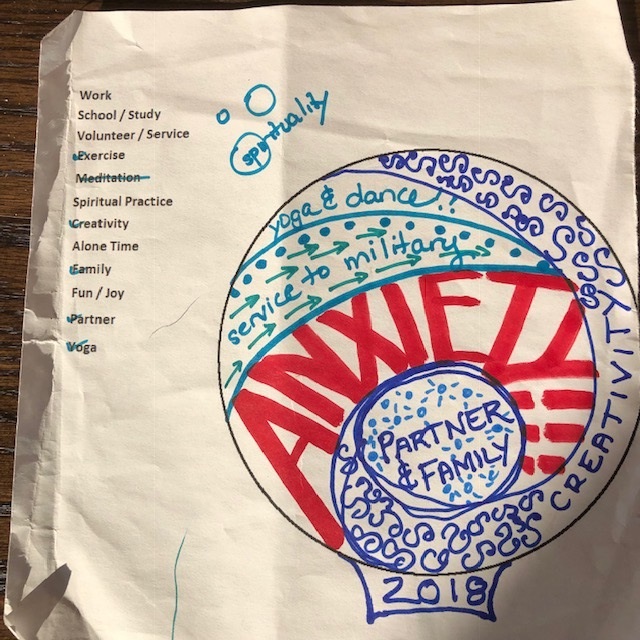
So I took her little paper and while everyone else was drawing accurate pies, I made myself a Fireball Chart.

A Fireball Chart is also about how you spend your time, but with urgency. Imagine yourself in that creepy hallway of Next Doors and visualize an enormous fireball chasing you down. That would make you knock on those Doors a whole lot faster, right?

Your fireball is made of six things:

1.      At the core, your most powerful motivator.

2.      At the edge, the activity you can’t help but do well and often.

3.      Something that feeds your soul.

4.      Something that gives back to your world.

5.      The thing that is uselessly burning up too much of your time.

6.      The urgency—why is a change so necessary to your ultimate survival now?

Here is the Fireball Chart I made:

blob

It is pretty darn accurate. It is also not the way I want to spend my time this year. I’ve got some ideas about how I am going to replace that big swath of anxiety, but I’m not doing them yet. All I know is that when I look at this Fireball Chart coming at me, I’m a lot more motivated to get on with it.

Download the Fireball Chart here and then send me a picture of yours!